
No Ottawa 72-Hour List
The Ottawa County detention page has no rolling recent-release feed. Mitchell County Jail, which Ottawa identified as its primary longer-term placement in April 2024, also states that it publishes no current-inmate list. No verified Ottawa sheriff app provides a hidden three-day view. The 72-hour window must therefore be reconstructed from calls, existing records, and court events.
The official Mitchell County Jail FAQ is captured below because its no-list policy controls the second local status check.
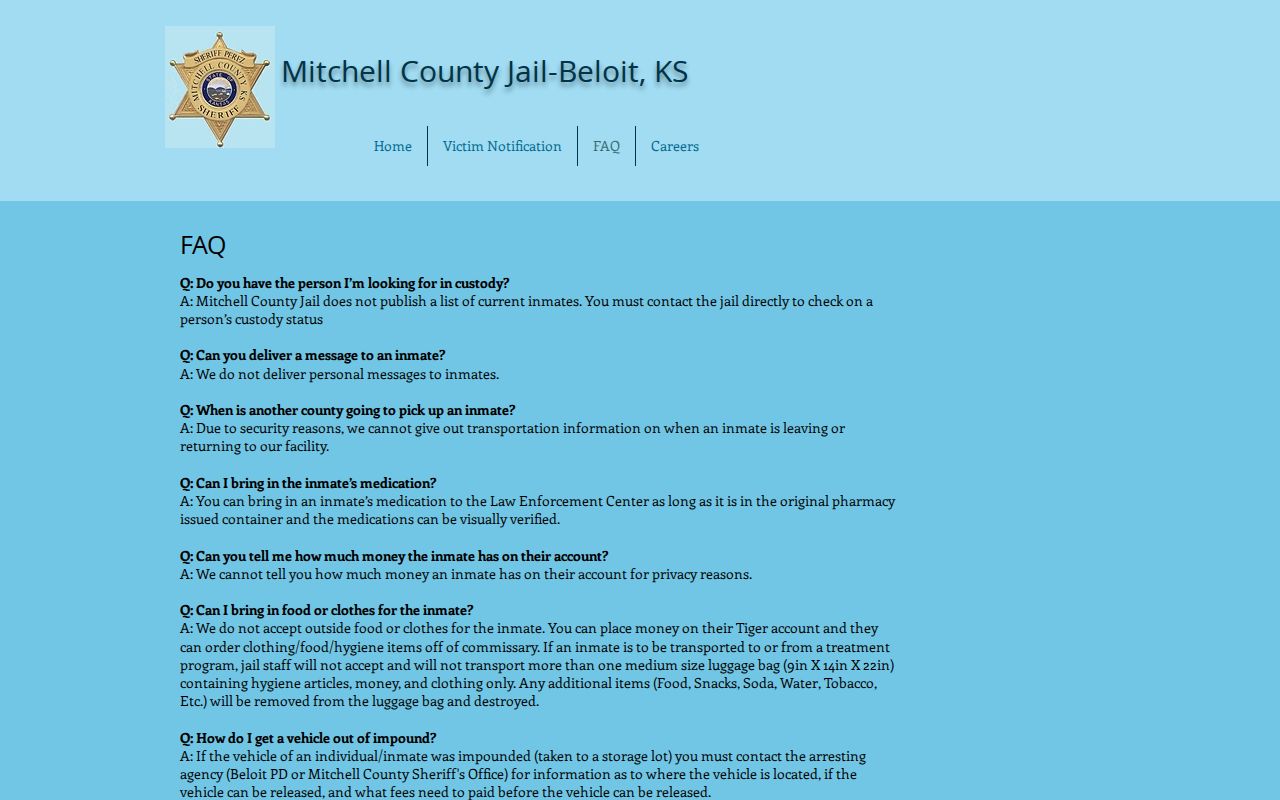
The captured policy makes a phone and records check necessary when Ottawa identifies Beloit as the placement location.
A three-day search has a broader aim than a same-day check. It should capture separate booking, transfer, court, and departure events that may fall on different dates. It can also expose a common mistake: Ottawa may record a person leaving Minneapolis while Mitchell records admission in Beloit. That pair proves continued custody, not community release.
Build Ottawa’s Three-Day Window
Set an exact start and end time before contacting an agency. “The last three days” can shift during the search, while a fixed range can be repeated across records. Call Ottawa County Detention Center at 785-392-2157 first for an Ottawa arrest. Provide the full name, likely booking date, and a case number or date of birth if needed. Ask for the recorded booking, departure, destination, and releasing authority within that range.
- Fix the range. Write down the start and end date and local time.
- Check Ottawa. Ask whether each event was a local release, transport, or transfer.
- Check Mitchell when named. Call 785-738-3523 for reception, present status, or departure in Beloit.
- Read the court chronology. Match bond, disposition, sentence, and release orders in the Kansas court portal.
- Use custody-specific tools. Check KASPER, VINE, BOP, or ICE only when that system fits the movement.
- Request existing records. Use KORA for a stable three-day event record.
Record the source and its “as of” time. A call on Monday may describe a Friday departure, while a state database may not show its next update until a working day. Never force all sources into one timestamp. Reconcile what each agency actually recorded.
Ottawa 72-Hour Record Fields
Ottawa publishes no feed field definitions. These fields are request terms drawn from the research inventory, not a representation of the jail’s screen labels. Ask for the existing booking register or jail-management entry and a narrow date range.
| Field | Use across three days |
|---|---|
| Name and booking number | Matches all events to one booking. |
| Admission date and time | Shows when local custody began. |
| Placement and transfer movements | Separates location changes from release. |
| Departure date and time | Fixes the physical change in custody. |
| Release type or destination | Shows community release or continued custody. |
| Court, case, and authority | Connects the event to its legal basis. |
The court order and jail event serve different roles. A bond or release order shows authority. The jail timestamp shows when physical departure occurred. If the person was housed in Mitchell, that facility’s entry supplies another needed time. Differences can reflect transport and processing, not a contradiction.
Ottawa Weekend Release Review
A 72-hour range is useful near weekends and holidays because it can reach back across days when offices or databases update on a different cadence. KASPER states that it updates each working day, and KDOC describes daily updates excluding weekends. VINE depends on the supplying agency. Ottawa has not published its weekend release procedure, exact processing times, or an online feed cadence. Those facts must remain open questions.
Start with Friday through Monday events as separate facts. A court entry on Friday does not prove the person walked out at that time. A jail departure on Saturday may be a transfer. A VINE alert delivered later may report the event after operations changed. Ask the actual custodian for the departure and destination, then use the filed order to explain the legal authority.
Holiday practice is also unverified. Do not assume a person must be held until the next business day, and do not promise release at a fixed hour. If immediate pickup or safety plans depend on timing, call the facility and use only the information it is permitted to provide.
Request Ottawa Three-Day Records
A Kansas Open Records Act request can preserve the wider window. Cite the person, booking date, and exact three-day span. Ask Ottawa for the booking number, admission, movements, departure, release type or destination, releasing authority, and case number. Request the existing electronic record rather than answers to a questionnaire.
K.S.A. 45-218 governs access to public records. K.S.A. 45-219 permits access and copy fees, while K.S.A. 45-221 lists exemptions. Ottawa has not published a jail-specific form, fee schedule, named custodian, or exact retention period in the reviewed sources. Ask for a cost estimate and for nonexempt fields to be separated from withheld material.
When Ottawa identifies Mitchell placement, ask Mitchell for admission, presence or departure, and the recorded destination. Return to Ottawa and the court for the controlling Ottawa case documents. This two-county check prevents a Minneapolis departure from being mislabeled as release to the community.
Ottawa Release Lists Fail Twice
The Mitchell County Jail FAQ expressly directs status inquiries to the jail instead of publishing a list. Ottawa’s official navigation also provides no roster or release archive. As a result, there is no reliable “watch the row disappear” technique at either point in the local custody path.
Phone and KORA checks carry more weight than copied lists. Ottawa should identify its departure and destination. Mitchell should confirm reception or its own later departure. The court should supply the order or disposition. A VINE alert can corroborate the event when the agency participates, but it cannot distinguish every transfer from community release without confirmation.
This three-source match is especially important across 72 hours. One event can fall on each of several days. A single date without its agency, event type, and time zone can obscure the sequence.
Compare Ottawa Release Windows
The two recent-release pages answer different time questions. The 24-hour method is best for an urgent same-day status check. The 72-hour method is built to reconcile a wider sequence, including weekends, delayed entries, and cross-county transport. Neither is an official feed because Ottawa publishes none.
| Window | Best use | Main risk |
|---|---|---|
| 24 hours | Call-based check of a very recent event | A later update may not yet appear |
| 72 hours | Reconcile court, jail, and transfer events | Several movements may be confused as one release |
| Named-person history | Trace one person through all custody systems | A name-only match can identify the wrong record |
Use the Ottawa County 24-Hour Releases route when the event may have occurred today. Use the Ottawa County released-inmate search when the time is unknown or the person may have entered state or federal custody.
Ottawa Custody Source Limits
KASPER applies only when the person entered a KDOC-operated or funded population. “Inmate” reflects state custody, while parole or postrelease may mean the prison portion ended with supervision continuing. “Discharged” indicates the KDOC obligation ended. A county bond release may never appear there.
VINELink may show a participating agency’s status or event. Search by name, ID, or case number and match the supplying agency. A no-match can reflect participation, retention, delay, spelling, or custody scope. VINE excludes federal inmates. Use the BOP locator for a federal sentence and ICE’s locator for immigration custody.
- Release
- Physical confinement ends under a named authority.
- Transfer
- Custody continues under a new agency or at a new place.
- Time served
- A court disposition credits the required custody time; the jail record still establishes departure.
- Detainer
- Another authority asks that custody continue or that it receive notice before release.
For an Ottawa event, the strongest package remains the Ottawa booking and departure record, the actual holding agency’s movement entry when different, and the court order. The three-day span helps collect those parts. It does not replace them.
Public Record Search
Sponsored Results