
Ottawa Detention Release Routes
A departure from the Minneapolis building has several possible meanings. A court may authorize bond, release on recognizance, dismissal, time served, sentence completion, or another community release. The Ottawa County Detention Center booking record should then carry a departure time and some form of release basis. Yet departure may instead be transportation to Mitchell County Jail in Beloit. It may be commitment to the Kansas Department of Corrections after sentence. Another county, the U.S. Marshals Service, or immigration authorities may also take custody under a warrant or detainer. Those outcomes are transfers, not freedom.
Ask the Ottawa County Sheriff to identify the event in plain terms. Useful fields include booking number, admission and departure times, release type, receiving agency or destination, court or case number, and the authority ordering the move. The court register and filed order explain why custody changed. The jail record says when the physical change occurred. Both records are needed when a label such as “released to Mitchell County” could be misunderstood.
Confirm Ottawa Detention Release
Ottawa County does not publish a current roster, a released-booking archive, or rolling recent-release feed. Start with the Sheriff because it owns the local booking event. Call with the full name, approximate booking date, and a case number or other identifier when names could match. Ask whether the recorded outcome was community release or transfer. If the answer names another custodian, continue with that agency instead of treating the Ottawa departure as the end of custody.
- Call Ottawa County Detention Center and request the current routing or recorded departure event.
- Write down the booking number, departure date and time, destination, and releasing authority that staff can provide.
- If Mitchell County is named, call its jail to confirm physical presence or later departure.
- If KDOC is named, accept the KASPER disclaimer and match the person by KDOC number or several identity fields.
- Search the Ottawa County court case for the bond, release, sentence, transfer, or disposition order.
- Request the existing Ottawa release or movement record when documentary proof is needed.
The broader Ottawa County released-inmate search explains how the county, court, KASPER, VINE, BOP, and ICE channels fit together. A live phone answer is best for routing. A dated record is stronger proof. VINE may corroborate an event from a participating agency, but its coverage and update time must be checked in the live result.
Ottawa Detention Records Contact
The Ottawa County Sheriff and Detention Center share the county facility address. The published main line can route a custody check. A Kansas Sheriffs’ Association directory also lists a jail administration line and round-the-clock jail hours, but that does not promise that administrative records staff answer at all hours. Email is useful for a focused written request. Ask the office to route it to the records custodian if another recipient is required.
Ottawa County Detention Center
Address: 312 N. Ottawa, Minneapolis, KS 67467
Main: 785-392-2157
Jail administration: 785-392-3625
Fax: 785-392-3659
Email: sheriff@ottawacounty.org or jail@ottawacounty.org
Jail hours: Listed as 24/7
A narrow Kansas Open Records Act request should identify the person and date range. Ask for the existing booking, custody-movement, and release entry, including admission and departure time, release type or transfer destination, releasing authority, case number, and any releasable booking photograph. Request electronic fields or reports rather than asking the agency to create a new explanation. Ottawa County publishes no special release-record fee table in the researched material. State law permits reasonable actual-cost fees and advance payment, so ask for an itemized estimate and set a cost ceiling.
Ottawa Detention Center Profile
The official county name is Ottawa County Detention Center and 911 Communications Center. It is operated by the Ottawa County Sheriff and sits behind the courthouse in Minneapolis. The static county page says the building opened in December 1996 and was designed for Ottawa County and contract prisoners. It reports capacity for 60 people. The Kansas Sheriffs’ Association directory describes 60 male beds and zero female beds.
The zero-female-bed listing raises a routing question. It does not support guessing which facility receives a particular woman. Call Ottawa County for the actual location. Likewise, older references to contract prisoners from Kansas counties, KDOC, INS, and federal sources describe historic operations. They do not prove any present contract or current custody owner.
Ottawa Jail Operations Changed
The facility’s static description must be read beside a later dated county record. In April 2024, the sheriff told Ottawa County commissioners that the jail had not closed. Budget shortfalls and a decline in outside and local prisoners had led the county to stop longer-term placement, while continuing short-term booking and transportation. The sheriff said Ottawa prisoners were primarily housed in Mitchell County at that time. Six Ottawa prisoners were reported at the meeting.
This distinction is unusually important for an Ottawa County release search. The building can remain open and process a booking even when the person sleeps elsewhere for the longer stay. The arrangement was a snapshot from April 8, 2024, not a permanent rule. Readers should review the county facility description for the standing facility facts, then confirm present operations directly with the Sheriff.
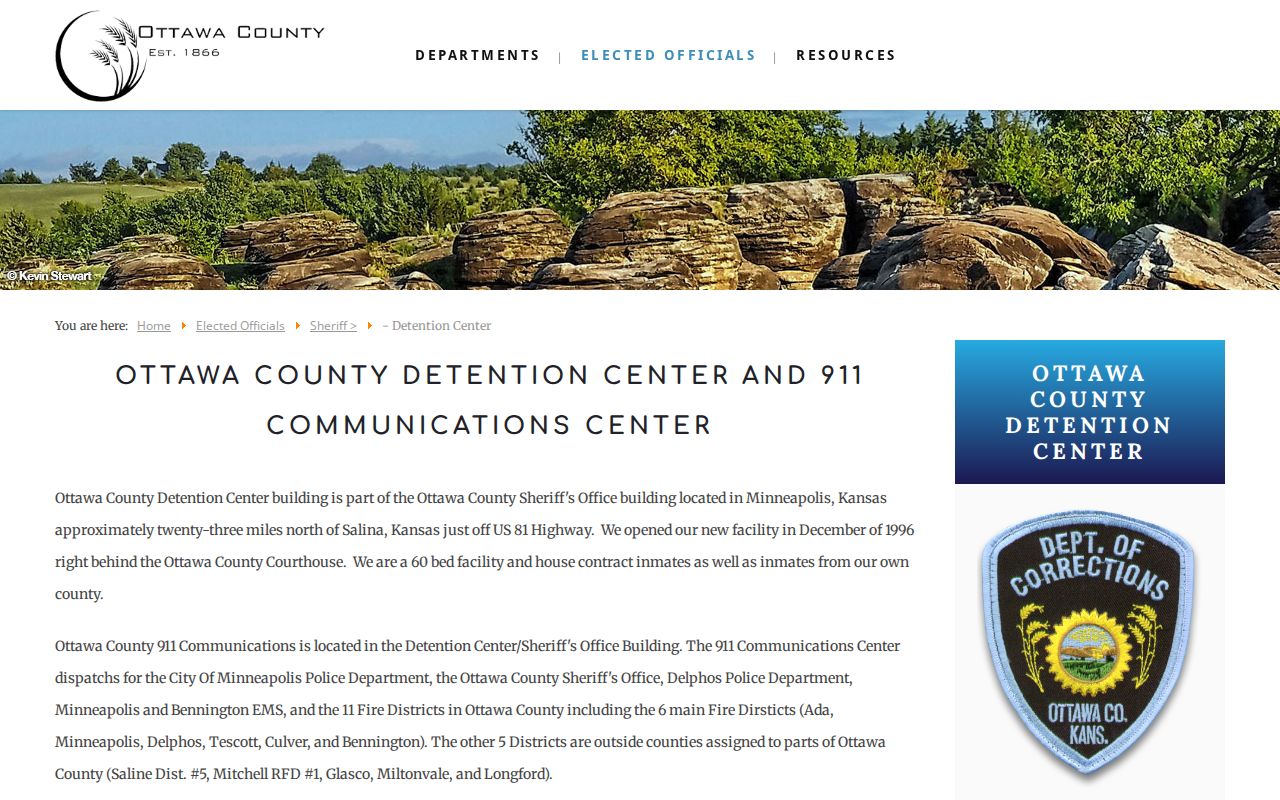
The successful facility screenshot below records that official source page. It supports the facility identity and contact path, but it does not provide a live roster or release list.
Read Ottawa Release Records
A county release entry is not the same as a final case result. Bond ends the detention component after processing but does not dismiss the charge. Time served may resolve a jail term, while probation can create duties outside the jail. A dismissal or acquittal is a court outcome. Each term answers a different question. Match the jail departure timestamp with the Ottawa County District Court register and, when wording matters, obtain the filed journal entry or release order.
Transfer labels need equal care. “Mitchell County,” “KDOC,” “other agency,” or a named jurisdiction usually describes continued custody. A detainer is a request or legal basis for another authority to take or hold the person. It can prevent a community departure even after the Ottawa case permits release. If the Ottawa entry and the court file appear to conflict, give both offices the same booking and case numbers and ask them to reconcile the destination.
KASPER should only be used if KDOC jurisdiction exists. It will not certify an ordinary Ottawa bond-out. BOP covers federal sentences, while ICE’s locator addresses immigration detention. A no-result in a system outside the event’s scope is not proof of release. The strongest local package is the Ottawa booking and departure record, the actual placement agency’s movement record when different, and the court authority.
Ottawa Release Proof Package
The Ottawa County District Court record supplies the legal side of a local departure. Search the Kansas District Court Public Access Portal by party, narrow to Ottawa County, and match the case number and charge. Review the register of actions for bond orders, dismissal, sentence, jail credit, probation, revocation, and satisfaction or discharge entries. Obtain the filed order when a short docket label leaves doubt. The clerk’s record can show authority, while the jail entry shows the physical departure time.
A Kansas Open Records Act request should remain narrow. Identify the person, booking or case number when known, and the smallest useful date range. Ask for existing booking, movement, and release fields, plus the releasable booking photograph if needed. K.S.A. 45-218 requires the agency to act on a request as soon as possible and no later than the end of the third business day. That rule is a response deadline, not a promise that all records will be produced by then. A delay response should explain the reason and earliest practicable availability.
K.S.A. 45-219 permits reasonable actual-cost fees and advance payment. Ask for an itemized estimate and set a ceiling before work begins. If a field is withheld, request the statutory basis and all reasonably segregable public portions. Preserve the sent request, agency response, estimate, and produced record together. This file gives a dated trail and prevents a phone summary from being repeated without the booking identifiers that support it.