
Ottawa Parole and Probation
Parole and probation can both place rules on a person living in Ottawa County, but they begin in different systems. KDOC Parole Services supervises people released from Kansas correctional facilities on parole, conditional release, or postrelease supervision. It also handles accepted interstate cases. Court services probation and community corrections are court-centered sentences. They do not, by themselves, prove that the person ever served a Kansas prison term.
The Kansas Prisoner Review Board decides suitability in eligible parole cases, sets conditions, addresses revocation, and performs discharge functions. A district judge controls probation orders. For an Ottawa County probationer, the court case and actual supervising agency are the better current sources, especially because KASPER has a known gap for community-corrections probation events after April 21, 2021.
| Record type | How it begins | Best verification source |
|---|---|---|
| Parole | Board-approved community release in an eligible state case | KASPER status, movement, and parole office |
| Postrelease supervision | Community phase after the prison part of a determinate sentence | KASPER plus the assigned KDOC office |
| Probation | Court sentence supervised in the community | Ottawa County court case and supervising agency |
| Discharge | Supervision and the KDOC obligation end | Dated discharge entry or formal certificate |
- Parole
- Conditional community release for an eligible person after part of a prison sentence.
- Probation
- A court-ordered community sentence that is distinct from state-prison parole.
- Postrelease supervision
- The supervised community portion that follows confinement under many Kansas guideline sentences.
- Discharge
- The end of the relevant supervision or sentence obligation.
Check Ottawa Post-Release Status
KASPER, the Kansas Adult Supervised Population Electronic Repository, is the primary public record for KDOC supervision. It includes people sentenced to the Secretary’s custody since 1980 who are incarcerated, under post-incarceration supervision, or discharged. It is not every Kansas arrest and not a complete criminal history. Use a KDOC number when known. Otherwise match first and last name with birth details, physical traits, conviction county, case number, or another stable field.
- Accept the KASPER disclaimer and locate the correct person. Do not select a record on name alone.
- Read the supervision type. “Inmate” means state custody. Parole, conditional release, or postrelease may mean the prison part ended while supervision remains.
- Check dated facility movements. A move between institutions is continued custody, not community release.
- Read the listed parole office, supervision level, conviction county, and case number. “Parole Supervision County: Ottawa” describes supervision geography, not a current address.
- For probation, review the Kansas District Court Public Access Portal for sentencing, assignment, violation, extension, revocation, and discharge orders.
- Contact the listed office or court custodian when a formal current answer is needed.
A blank KASPER search is not proof that Ottawa County supervision ended. A local detainee may never have entered KDOC, and the community-corrections display limitation can leave newer probation events out. Use dated affirmative evidence. The court file may preserve the order after a jail stay or online event is no longer visible.
Ottawa Supervision Routes Through Salina
Ottawa County is assigned to the Salina Parole Office, North Region. That regional assignment covers 13 counties. The public verification chain is specific: locate the correct KASPER entry, read its supervision and office fields, then route a case-specific question through the office shown in the record. The automated number used by supervisees to report is not a public locator.
919 E. Prescott, Suite 300
Salina, KS 67401
785-827-2584
The regional office does not turn probation into parole. Court services or Community Corrections may oversee an Ottawa County probation case. Start with the filed sentencing order and confirm the named agency. If the portal summary is unclear, obtain the actual journal entry from the Ottawa County District Court rather than assuming that an old KASPER line is current.
The office screenshot below comes from the official KDOC parole office directory.

Use the directory after KASPER identifies the responsible region; the office list alone does not prove that a named person is supervised there.
Ottawa Parole Absconder Records
Kansas publishes separate KASPER paths for parole absconders and Community Corrections absconders. The parole tool can filter Ottawa County as the last supervision location and can optionally display photographs. This is a strong geographic clue, but it has narrow meaning. It does not disclose a current home, locate the person now, show the convicting county, or prove present jail custody.
Under K.S.A. 75-5217, absconding concerns knowingly avoiding supervision or knowingly making one’s whereabouts unknown to the responsible officer. An entry alleges supervision noncompliance. It is not a new conviction. KASPER updates on working days, so the displayed status may lag a weekend event, arrest, or office action.
The official parole absconder search shows the location filter used for an Ottawa County record check.
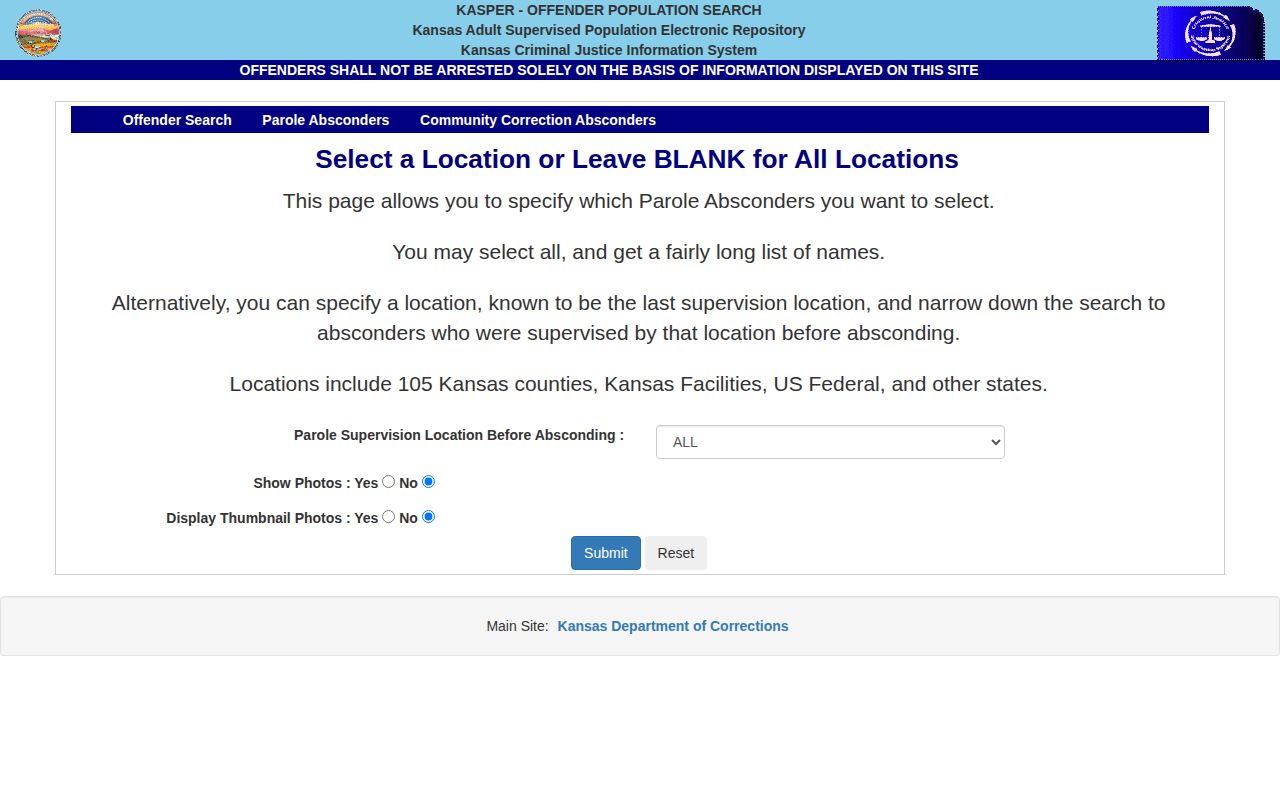
Match identity and read the last supervision location as a historical office field, then seek dated confirmation from the responsible agency.
For absconder information, KDOC lists Enforcement, Apprehensions and Investigations at 785-414-7755. That line is not a general release-record service. A person with a violation warrant may later return to custody, so an older prison release date should never be treated as permanent freedom.
Ottawa Parole Hearing Status
The Prisoner Review Board’s schedule is a rolling pipeline, not a results archive. Public-comment forums occur one month before eligibility hearings. A listed person has not thereby been granted parole or physically released. The Board uses three official terms: parole means a finding of suitability subject to release processing; continue means more deliberation, information, votes, or review; pass means denial for a stated period.
The official-source review found no searchable person-by-person database of final Board decisions. Follow the KASPER status and movement after the hearing. If the result must be documented, request the Board action record from the Prisoner Review Board at 714 SW Jackson, Suite 300, Topeka, Kansas, 785-746-7516. A favorable decision can still be followed by planning work, another hold, or an intervening event.
K.S.A. 22-3717 contains offense- and date-specific eligibility rules. Eligible older indeterminate cases may receive discretionary review. Guideline determinate cases generally move under a computed prison and postrelease structure instead. No single eligibility formula fits every Kansas sentence.
Ottawa Violations and Discharge
Supervision conditions are the rules imposed by the Board, court, and supervising agency. A reported violation can prompt investigation, a warrant, a hearing, changed conditions, or revocation. Revocation means supervision is withdrawn and the person may return to custody. A VINE alert can report a later custody event when the supplying agency participates, but it does not replace the supervision record or filed court order.
Discharge is the key end point. In KASPER, “Discharged” indicates the state obligation has ended. For formal proof, request the existing movement and release record or maximum-sentence discharge certificate using the KDOC number and case. For court probation, locate a discharge or satisfaction entry and obtain the filed order if its wording matters. The Ottawa County released-inmate search path explains how jail, court, and state records answer different parts of a release question.
Kansas expungement under K.S.A. 21-6614 is separate from discharge. Eligibility depends on the event, offense, completion, and the end of probation, community corrections, parole, postrelease supervision, or another sentence. A missing online result should not be interpreted as proof of either expungement or release.
Records from separate agencies should be reconciled instead of forced into one timeline. KASPER can establish a KDOC status and office. The Prisoner Review Board can document a parole action. The Ottawa County court can supply a probation, violation, or discharge order. A jail can document a later physical booking or departure. When two entries appear to conflict, compare their effective dates, filing dates, case numbers, and the agency responsible for each event. A court order signed on one day may be entered later, and a working-day KASPER update may trail the physical event.
Formal KDOC confirmation should identify the person by KDOC number and case. Ask for the existing movement or release record, the Board action when relevant, or the maximum-sentence discharge certificate. For Ottawa County probation, request the filed journal entry rather than a verbal summary when the distinction between extension, revocation, and discharge matters. A focused request is more useful than asking an office to compile a broad history it does not keep as one record.
Notification systems have a narrower role. A VINE event may help a family member or other registered user learn of a custody change from a participating supplier. It does not state whether parole rules continued, whether a court probation term remained open, or whether KDOC later discharged the sentence. Follow the alert with the supervision record that answers the actual question.
Do not substitute an absconder list for the full supervision check. The list shows a particular alleged failure to remain in contact. A person can be actively supervised without appearing there, and an older result can change after an arrest or agency action. Current status comes from the matched KASPER record, the assigned office, and any later Board or court document.
Keep the final evidence dated: the matched identity, supervision type, last movement, assigned office, and any filed discharge or revocation order. That record chain distinguishes a person living in the community under rules from someone whose sentence obligation has fully ended.