
Mitchell County Release Routes
Mitchell County Jail belongs in the Ottawa County facility map because Ottawa officials identified it as the primary longer-term placement destination in April 2024. That statement was a dated operating snapshot and may have changed. Ottawa’s answer should route any named inquiry. When Ottawa says a person was “released to Mitchell County,” the phrase describes transfer from Minneapolis to custody in Beloit. It is not a community release.
A later Mitchell departure may have several destinations. The person might leave under an Ottawa court order, return to Ottawa for court or transport, enter Kansas Department of Corrections custody after sentence, or go to another jurisdiction. Ask Mitchell for the recorded departure time and destination. Ask Ottawa and the district court for the commitment or release authority. These records may carry different times because transport, intake, court action, and final release processing are separate events.
Mitchell’s official FAQ does not disclose intercounty transport timing. That limit protects movement security and prevents reliable guesses about pickup hours. Do not infer a route from silence or from the timing of a phone response. For personal release planning, contact the jail and the attorney or court channel tied to the case without asking staff to reveal protected transport details.
Confirm Mitchell Jail Release
No online Mitchell County current-inmate list or recent-release list exists. Its official FAQ directs status inquiries to the jail. Begin with a full name and enough identifying context to avoid a same-name error. State that the arrest or commitment came from Ottawa County. Ask only whether the person is physically present, has departed, or was returned or transferred to another custodian.
- Call Ottawa County first to verify that Mitchell is the actual placement location.
- Call Mitchell County Jail and ask about current presence or a recorded departure.
- Record the date, destination, and releasing or committing agency staff can disclose.
- Search the Ottawa County court case for the order controlling bond, sentence, transfer, or release.
- Request Mitchell’s existing admission and departure entry for documentary proof.
- Request Ottawa’s booking and commitment record so the two custody trails can be reconciled.
The Ottawa County release search guide explains when to continue to KASPER, VINE, BOP, or ICE. KASPER matters only if the person entered KDOC custody. It does not prove a Mitchell County bond release. VINE can corroborate an event if the supplying agency participates, but the record’s “as of” time and exact event wording matter.
Mitchell Jail Records Contact
Mitchell County Jail publishes a street address, mailing box, main phone, and email. The phone is the official fallback for a current status question because the jail expressly declines to publish an inmate list. A written request is better when the goal is a dated admission, movement, or departure record. Identify Ottawa County as the committing agency and give a narrow date range.
Mitchell County Jail
Street: 1716 N. Hersey, Beloit, KS 67420
Mail: P.O. Box 338, Beloit, Kansas
Phone: 785-738-3523
Email: mcjail@nckcn.com
Under the Kansas Open Records Act, request the existing admission, custody-movement, and departure entry. Useful requested fields include full identifying name, booking or local identifier, admission date and time, committing agency, departure date and time, destination or releasing agency, and any releasable photograph. These are request terms, not a claim about Mitchell’s software labels. Ask for existing electronic material and segregable public portions. State law allows reasonable actual-cost fees and advance payment, so request an estimate before costs pass a set ceiling.
Mitchell Jail Serves Ottawa
Mitchell County operates this county jail in Beloit. It is not an Ottawa County building, a regional state prison, or a KDOC institution. Its relevance comes from Ottawa County’s April 2024 statement that longer-term Ottawa prisoners were primarily housed there while Ottawa continued short-term booking and transportation. Current placement must be reconfirmed for each person because the research found no permanent contract term or later statement proving the same arrangement in July 2026.
Physical location and case ownership can therefore split. Mitchell staff can address whether someone is held in Beloit and what its custody record shows. Ottawa County Sheriff retains the local booking and transfer record. Ottawa County District Court supplies the legal case history. If a state sentence follows, KDOC becomes the custody owner and KASPER becomes the appropriate public locator. Keeping those roles distinct prevents a transfer from being mislabeled as release.
Mitchell Has No Release List
The official Mitchell County Jail FAQ states that the jail does not publish a current-inmate list and directs inquiries by phone. The successful manifest screenshot captures that official fallback. It is not evidence about any named person, and it does not show a release window.
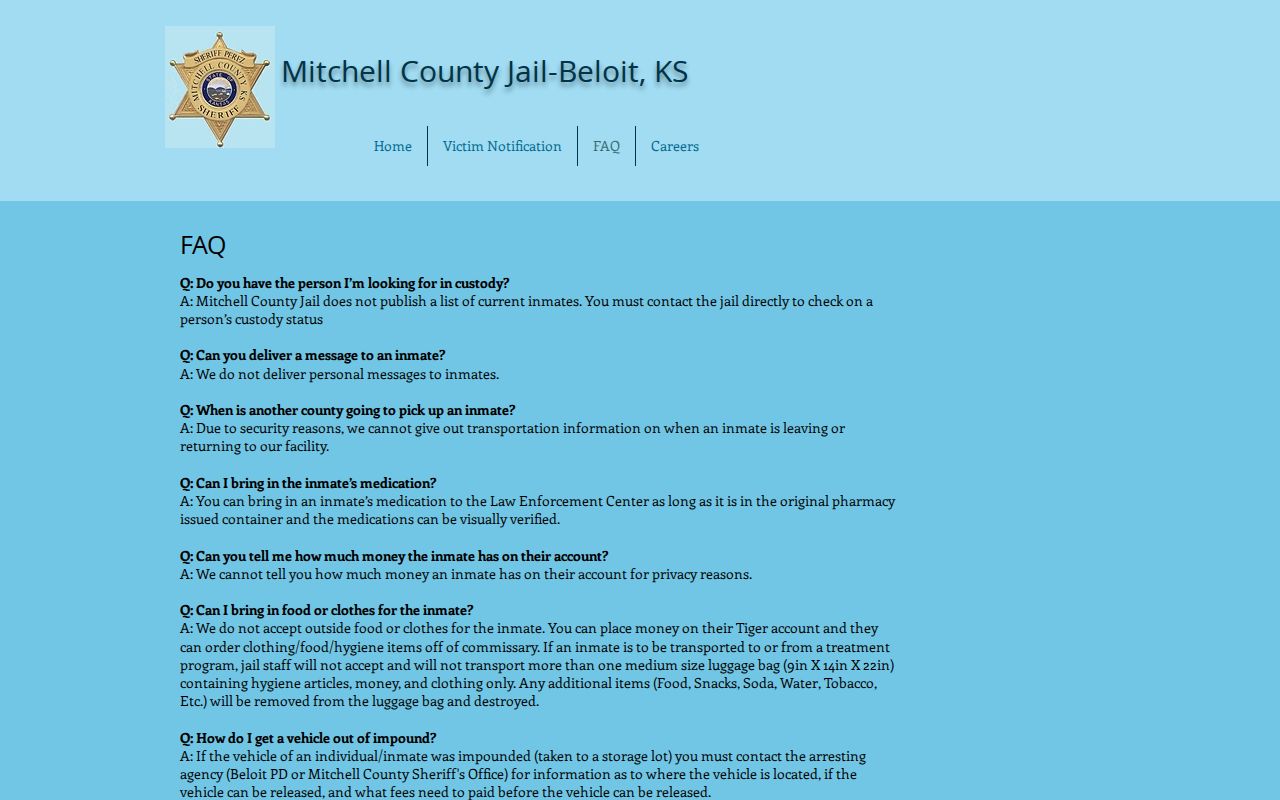
Because no feed exists, there is no supported 24-hour or 72-hour retention period, update cadence, or booking-photo display to describe. Commercial mirrors cannot supply an official county answer. A timestamp from an outside page may be stale, tied to another county, or detached from the actual release authority. Use the jail and court records instead.
Mitchell Release Property Procedure
Mitchell County publishes one useful local procedure. A confined person may authorize release of property to a named recipient on a Release of Property form. The recipient must show proper identification. Evidence remains an issue for the arresting agency rather than ordinary personal-property release. This policy belongs to Mitchell County custody and should not be presented as Ottawa County’s procedure, which was not established in the research.
Property release also does not establish that the person has left jail. Someone can authorize another person to retrieve property while remaining confined. Ask a separate custody question and obtain the departure entry when release timing matters. If an Ottawa arrest produced evidence, route that part of the inquiry to the arresting agency. The property form only governs the personal items Mitchell agrees to release.
Read Mitchell Departure Records
A departure notation should be read with its destination. Community release under bond, time served, dismissal, or a court order differs from transfer back to Ottawa, commitment to KDOC, or pickup on another warrant. A detainer is a legal request by another authority to hold or receive the person. It can block community release even when the Ottawa matter permits departure.
The best proof joins Mitchell’s physical departure entry with Ottawa’s court authority. A bond order does not itself timestamp the moment someone walked out. A jail movement entry may abbreviate the legal reason. When the dates or terms differ, provide both agencies the same name, booking identifier, case number, and date range. Ask for reconciliation rather than selecting the most convenient source.
If KDOC took custody, search KASPER by KDOC number when known and inspect supervision type and dated movements. “Inmate” reflects state custody. Parole or postrelease can reflect a prison departure with supervision still active. “Discharged” means the KDOC obligation ended, subject to the repository’s limits. None of those state labels should be imported into a person’s earlier Mitchell jail stay.
Build Mitchell Release Proof
Begin with Ottawa’s booking record because it explains why the person entered the local custody chain. Then obtain Mitchell’s admission and departure entry if Beloit became the physical placement. Finally, pair those movements with the Ottawa County court order. This three-part set distinguishes a transfer from a true community departure and shows which office supplied each time. It also helps explain why Ottawa’s closing time and Mitchell’s intake time may not match.
A phone check can answer where to route the next inquiry, but write down the date, office, and exact wording. Do not turn “not here” into “released.” Ask whether staff can say the person departed, returned to the committing county, entered another agency’s custody, or was released under an order. When the answer cannot be given by phone, request the existing record. Avoid asking staff to predict transport or disclose a protected movement schedule.
If the Ottawa court shows bond or time served, compare that authority with Mitchell’s physical departure. If it shows commitment to KDOC, continue to KASPER and read state movements. If another warrant or detainer controlled the next move, use the named custodian. Each source should be kept within scope. Mitchell confirms its jail event, Ottawa confirms its booking and case, and KDOC or a federal agency confirms any later custody.